
E-Way Bill Validity: Rules and Calculator
An e-way bill for normal cargo is valid for 1 day for every 200 km (or part of it). For over-dimensional cargo it's 1 day per 20 km. Each “day” ends at midnight of the following day, counted from when Part B is first entered. Validity can be extended near expiry, but total validity can't exceed 360 days.
On this page
E-way bill validity calculator
Runs in your browser. Nothing you enter is sent anywhere.
Validity rules under Rule 138(10)
| Type of conveyance / cargo | Distance | Validity |
|---|---|---|
| Normal cargo (other than ODC) | Up to 200 km | 1 day |
| Normal cargo (other than ODC) | Every additional 200 km or part | 1 additional day |
| Over-dimensional cargo (ODC) | Up to 20 km | 1 day |
| Over-dimensional cargo (ODC) | Every additional 20 km or part | 1 additional day |
The 200 km figure applies from 1 January 2021. Earlier rules used 100 km per day, and some older guides still quote that figure.
Over-dimensional cargo means cargo carried as a single indivisible unit that exceeds the dimensional limits in Rule 93 of the Central Motor Vehicles Rules, 1989.
Distance table: examples
| Distance | Normal cargo | Over-dimensional cargo |
|---|---|---|
| 50 km | 1 day | 3 days |
| 200 km | 1 day | 10 days |
| 201 km | 2 days | 11 days |
| 450 km | 3 days | 23 days |
| 1,000 km | 5 days | 50 days |
| 2,150 km | 11 days | 108 days |
How a “day” is counted
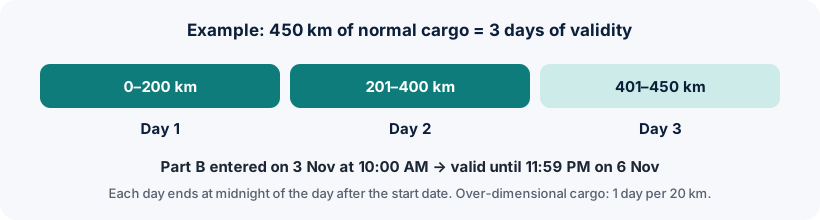
Validity is counted from the time the e-way bill becomes valid (when Part B is first entered), and each day ends at midnight of the day immediately after. So an e-way bill for 150 km with Part B entered at 10:00 AM on 3 November is valid until 11:59 PM on 4 November, not until 10:00 AM on 4 November.
Extending validity
- If goods can't reach the destination in time (for example, because of a breakdown, accident, transhipment or law-and-order issue), validity can be extended on the portal.
- The portal allows extension in a window around expiry, from 8 hours before to 8 hours after the e-way bill expires.
- You give the reason, the current place and the remaining distance. The portal then adds validity based on the remaining distance.
- Extension is done by the generator or the transporter currently responsible for the goods, after logging in.
The 360-day maximum
From 1 January 2025, the total validity of an e-way bill, including all extensions, can't go beyond 360 days from the date it was first generated. After that, a fresh e-way bill would be needed, and only if the base document is still within the 180-day limit.
Distance and PIN codes
The portal calculates the approximate distance between the dispatch and delivery PIN codes and shows it while you generate the e-way bill. You can enter a slightly different distance to reflect the actual route, but the portal only accepts a limited margin above its calculated distance. Where both PIN codes are the same, you enter the actual distance within the allowed limit.
Frequently asked questions
How is e-way bill validity calculated?
For normal cargo, 1 day for every 200 km or part of it; for over-dimensional cargo, 1 day for every 20 km or part of it. Each day ends at midnight of the following day.
What is the validity of an e-way bill for 100 km?
1 day for normal cargo, ending at midnight of the day after Part B is first entered. For over-dimensional cargo it's 5 days.
When can I extend an e-way bill?
The portal allows extension within a window from 8 hours before to 8 hours after expiry, giving the reason and remaining distance.
Is there a limit on how many times an e-way bill can be extended?
From 1 January 2025, total validity including extensions can't exceed 360 days from the original generation date.
Does validity start when the e-way bill is generated?
Validity starts when Part B (vehicle or transport document details) is first entered. If Part A and Part B are entered together, that's at generation.
Ready to log in?
Use only the official government portal. ewaybillogin.com never asks for your password or OTP.
Official sources and references
- CBIC GST portal: CGST Act and Rules (opens official site in a new tab)
- Advisory on updates to E-Way Bill (PDF) (opens official site in a new tab)
- E-Way Bill FAQs (official documentation) (opens official site in a new tab)
- E-Way Bill System (official portal) (opens official site in a new tab)
We check these sources before each review. Portal screens and rules can change, so if something here differs from what you see on the official portal, follow the portal and tell us.