
What Is an E-Way Bill?
An e-way bill (electronic way bill) is a document generated on the government's E-Way Bill System for the movement of goods. Under GST it's generally required when goods worth more than ₹50,000 are moved. It records the goods, the parties and the vehicle, and carries a 12-digit e-way bill number.
On this page
E-way bill meaning and full form
EWB stands for Electronic Way Bill. A “way bill” is a document that travels with goods. Under GST it has been replaced by an electronic record generated online, so tax officers can verify a consignment without stopping it for long. The national E-Way Bill System was rolled out for inter-state movement from 1 April 2018, with intra-state movement following in phases across states.
Legal basis
- Section 68 of the Central Goods and Services Tax Act, 2017 allows the government to require documents for goods in movement.
- Rule 138 of the CGST Rules, 2017 (with Rules 138A to 138E) sets out when an e-way bill is needed, who generates it, validity, verification and blocking.
When is an e-way bill required?
An e-way bill is generally required before goods are moved when the consignment value exceeds ₹50,000, whether the movement is:
- in relation to a supply (for example, a sale);
- for reasons other than supply (for example, sending goods for job work or returning goods); or
- an inward supply from an unregistered person.
Some movements need an e-way bill even below ₹50,000, such as inter-state movement of goods sent by a principal to a job worker, and inter-state movement of handicraft goods by persons exempted from registration. States can set their own thresholds for movement within the state. See e-way bill limit.
Who generates the e-way bill?
| Situation | Who generates it |
|---|---|
| Registered supplier sends goods | The supplier (or the recipient, or the transporter on their behalf) |
| Registered person receives goods from an unregistered supplier | The recipient, as if they were the supplier |
| Neither party generated it and goods are handed to a transporter | The transporter, based on the documents received |
| Unregistered transporter carrying goods | Uses a Transporter ID to update Part B |
What an e-way bill contains
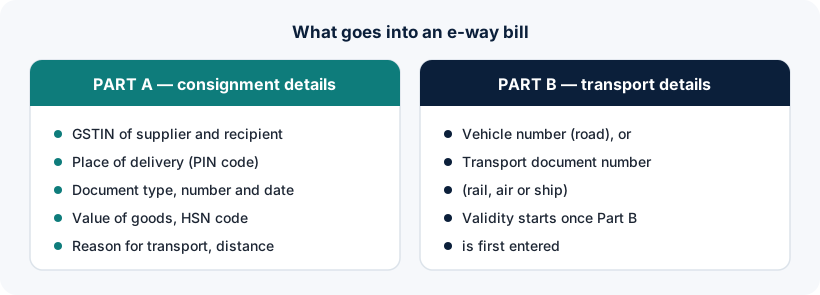
Part A has the consignment details: GSTINs, place of delivery, document number and date, value, HSN codes and reason for transport. Part B has the transport details: the vehicle number for road, or the transport document number for rail, air or ship. More in how to generate an e-way bill.
Worked example
Sharma Textiles in Jaipur sells fabric worth ₹1,20,000 (including GST) to a shop in Delhi. Because the movement is inter-state and the value is above ₹50,000, an e-way bill is needed.
- Sharma Textiles logs in to the E-Way Bill portal and fills Part A with the invoice number, date, both GSTINs, the Delhi PIN code, HSN codes and value. The distance is about 280 km.
- The transporter's GSTIN or Transporter ID is entered, and the truck number is added in Part B.
- The portal generates a 12-digit e-way bill number. At about 280 km, the e-way bill is valid for 2 days (1 day for the first 200 km and 1 more day for the next 80 km).
- The driver carries the invoice and the e-way bill (or its number). The Delhi shop can see the e-way bill in its account and has 72 hours to reject it if it's wrong.
Exemptions: an overview
Rule 138(14) lists situations where no e-way bill is needed. They include, among others:
- goods moved by a non-motorised conveyance;
- goods moved from a port, airport, air cargo complex or land customs station to an inland container depot or container freight station for customs clearance;
- goods specified in the annexure to Rule 138, and goods exempted from tax by notification;
- empty cargo containers;
- movement of goods up to 20 km from the place of business to a weighbridge for weighing, under a delivery challan.
States can also notify their own exemptions for intra-state movement. Check the exact wording in Rule 138(14) and your state's notifications before relying on an exemption.
What if goods move without a required e-way bill?
If goods that need an e-way bill are moved without one, or with wrong details, the goods and vehicle can be detained under Section 129 of the CGST Act, and penalties can apply. Release usually requires payment of the applicable penalty. The exact amount depends on the case, so take professional advice if this happens.
Frequently asked questions
What is the full form of EWB?
EWB stands for Electronic Way Bill.
What is an e-way bill in simple words?
It is an electronic document, generated on the government's E-Way Bill System, that records details of goods being moved, the parties and the vehicle. It is generally needed when the consignment value is more than ₹50,000.
Is an e-way bill required for goods worth less than ₹50,000?
Usually not, but there are exceptions, such as inter-state movement to a job worker and inter-state movement of certain handicraft goods. State thresholds for intra-state movement can also differ.
Who is responsible for generating the e-way bill?
The registered person causing the movement, usually the supplier or recipient. If neither has generated it, the transporter must generate it based on the documents received.
Where is the e-way bill generated?
On the official E-Way Bill portal at ewaybillgst.gov.in (or the E-Way Bill 2.0 portal), or through authorised API/GSP integrations.
Ready to log in?
Use only the official government portal. ewaybillogin.com never asks for your password or OTP.
Official sources and references
- CBIC GST portal: CGST Act and Rules (opens official site in a new tab)
- E-Way Bill FAQs (official documentation) (opens official site in a new tab)
- E-Way Bill user manual (PDF) (opens official site in a new tab)
- E-Way Bill System (official portal) (opens official site in a new tab)
We check these sources before each review. Portal screens and rules can change, so if something here differs from what you see on the official portal, follow the portal and tell us.